Preserve engineering intent across the asset lifecycle.
ActivityExchange anchors every field activity, completion record, and approval to the live digital system model — so design, delivery, and operations remain a single, traceable thread.
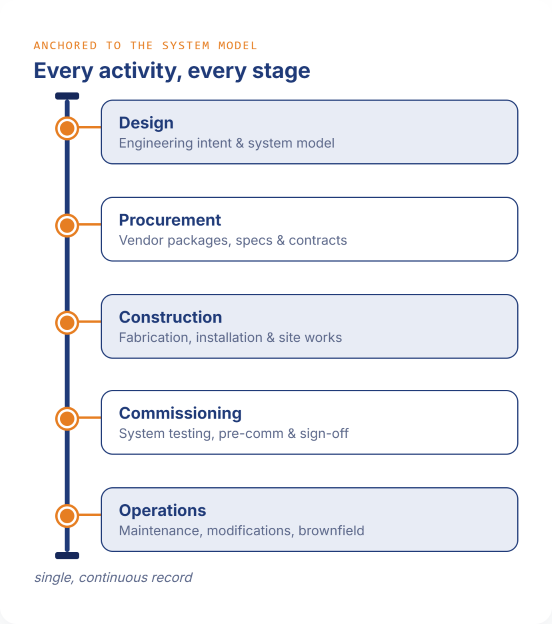
Conventional project tools manage tasks. Document repositories store files. Neither preserves the connection between the work performed in the field and the engineering model that governs it. At handover, that connection is typically lost — and with it, the evidence operations teams depend on for the next thirty years. ActivityExchange exists to prevent that loss.
From model to proven — in two minutes
A short film on how ActivityExchange holds engineering intent, field execution and completion evidence on one connected record.
2:16 — captions are burned in, so it plays fine with the sound off.
Why engineering organisations choose ActivityExchange
A platform designed around how complex assets are actually delivered, verified, and operated — not a generic task tracker adapted after the fact.
Information loss is a structural risk, not a process problem.
In most engineering programmes, design intent lives in one system, field execution lives in another, and completion evidence lives in a third. Spreadsheets, email threads, and document drops bridge the gaps. Each handoff degrades the link between what was specified, what was built, and what was approved. By the time the asset reaches operations, reconstructing that lineage is expensive — and in regulated environments, sometimes impossible. ActivityExchange addresses this at the structural level: work is defined against the design model, executed against the model, and recorded against the model. Continuity is the default, not an after-the-fact reconciliation exercise.
Activity-centred delivery, anchored to the system model.
Every activity in ActivityExchange is bound to the components, systems, and disciplines it affects. Field teams do not work against detached task lists; they work against a living representation of the asset. This matters because it means the people performing the work always see the engineering context behind it, and the engineering team always sees how their intent is being realised. The model and the work evolve together.
Engineering, field, and completion workflows operate on the same record.
Disciplines, contractors, commissioning teams, and asset owners contribute to one structured record per activity. This eliminates the parallel tracking systems that typically emerge on large programmes — and the reconciliation work they generate. When a query arises months or years later, the answer is in one place, with provenance attached.
Traceability, compliance, and auditability are built in.
Approvals, status changes, attribute updates, and evidence are captured as a permanent, attributable history against the activity and the model element it relates to. This matters because audit and assurance evidence is no longer a deliverable that has to be assembled at the end of a project — it is a continuous by-product of how work is performed.
Continuity from delivery into operations.
When a project completes, the model and its activity history transfer intact to the operating organisation. Maintenance, modifications, and brownfield extensions begin from a verified baseline rather than a reconstructed one. The platform that delivered the asset becomes the platform that operates it — without a translation layer.
Why generic tools cannot do this
The difference is structural. It cannot be closed by adding integrations or custom fields to tools designed for a different purpose.
Task-based project tools
Designed to coordinate people.
Tasks are tracked as standalone items. They have no inherent relationship to the system model, the engineering attributes, or the completion evidence. Once a task is closed, its connection to the asset is lost.
Document repositories
Designed to store files.
Drawings, specifications, and certificates are filed alongside one another, but the relationships between them — and to the physical asset — must be inferred. Searching for "what was approved, by whom, against which revision" is a manual, error-prone exercise.
Ad-hoc handover processes
Designed to satisfy a milestone.
Handover packages assembled at the end of delivery freeze information at a single point in time. Their structure rarely matches how operations teams need to query the asset, and any subsequent change reopens the same reconciliation problem.
Designed to preserve engineering intent.
Activities, evidence, approvals, and the system model are a single connected record. Delivery and operations work on the same structure. Lifecycle continuity is the architecture, not a process bolted on top.
Refined in real delivery environments
ActivityExchange has been developed and hardened over years of use on complex greenfield and brownfield programmes — not in a product lab.
Built for complex assets
Multi-discipline scope, long delivery horizons, regulated environments, and overlapping contractor teams are the conditions ActivityExchange was designed for — and is used in today.
Greenfield and brownfield
The platform supports both new-build delivery and modifications to existing assets, where preserving the historical record of why something was changed is as important as the change itself.
Operational, not aspirational
Every capability described here is in production use. The platform has been refined through the constraints, exceptions, and edge cases that only real delivery environments expose.
Let's talk about how you deliver.
ActivityExchange suits some delivery environments better than others. A short conversation — grounded in how your work actually runs — is the quickest way to tell whether it suits yours.